New Build
A Sculptural, Sustainable Home Inspired by Cotswold Heritage
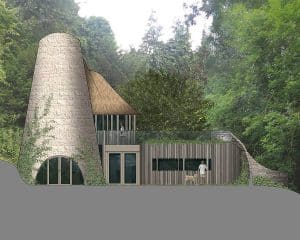
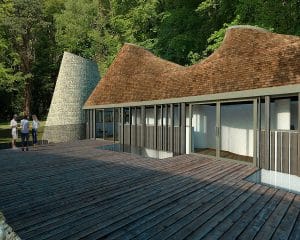
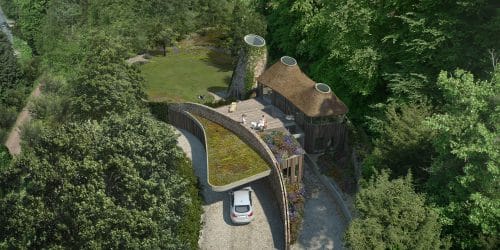
Set within a 2.3-acre glade on the outskirts of Cheltenham, Flight Farm is a bold and sustainable new Paragraph 84 dwelling to both its rural surroundings and rich local history. The new home is arranged to preserve the site’s two existing clearings, ensuring uninterrupted views over the wider Cotswolds landscape. Drawing on the region’s heritage of lime baking and quarrying, the home’s defining feature is an 11.7-metre chimney with a circular skylight—a sculptural nod to the historic lime kilns scattered across the area. This striking element anchors a carefully considered home that celebrates place, passive performance, and poetic design.
Atmosphere
Living against the Hills
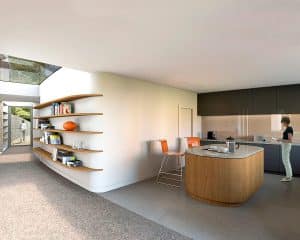
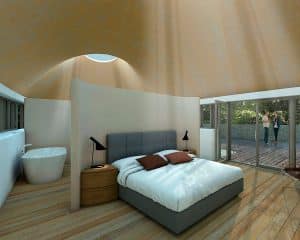
The interior of Flight Farm is designed to feel both grounded in its landscape and elevated by light. A top-lit hallway forms a dramatic visual axis, drawing the eye from the front entrance straight through to the rear garden, connecting inside and out. At the heart of the home, the double-height kiln living space is bathed in natural light from above, while glazing and garden doors open directly onto the landscape, blurring boundaries between indoors and nature. In the master bedroom, views unfold in every direction beneath a lifted roofline, culminating in a central skylight that brings the treetops—and the stars—into the room.
Inspiration
A Contemporary Home Embedded in the Industrial Past of the Cotswolds
Flight Farm sits within a landscape steeped in history, where the rising land to the west forms an ancient escarpment once carved by centuries of limestone quarrying. Remnants of this industrious past remain embedded in the terrain: linear earthworks from 18th and 19th-century gravity-operated tramways still trace across the slope, while the foundations of old lime kilns speak to when stone from this very site helped shape the Cheltenham landscape. Public footpaths weave past the farm, flanked by signs of past settlement that speak to a long-inhabited and well-trodden place. The striking chimney form in the new dwelling draws direct inspiration from this heritage—most notably the Devil’s Chimney, a peculiar outcrop in the local stone workings. By rooting the architecture in the land’s historic rhythms and material memory, the design ensures that Flight Farm feels deeply connected to the past while looking firmly toward a sustainable future.
Iterations
Modelling
A rigorous process of sketching and physical model-making was central to developing a home that feels grounded in its setting. Iterative studies allowed the design to evolve in response to the site’s natural contours, historic context, and changing light conditions. These hands-on explorations helped refine the building’s massing, orientation, and relationship to the landscape—ensuring that the final proposal is not only distinctive but also deeply rooted in place.